
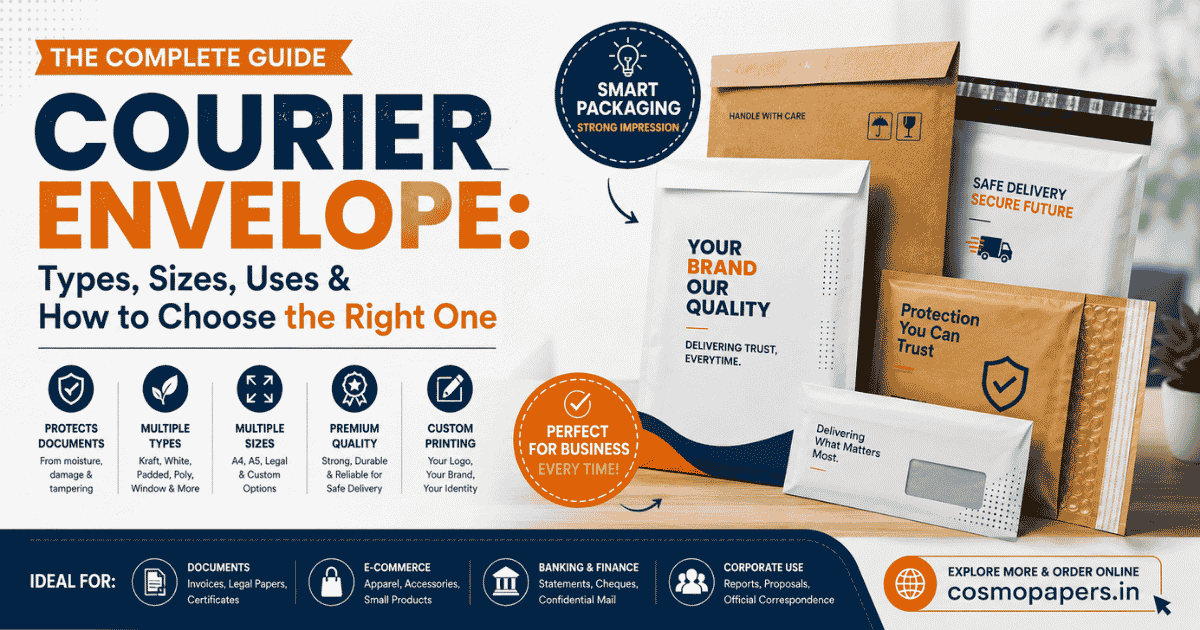
Courier Envelope: Types, Sizes, Uses & How to Choose the Right One
A courier envelope is a durable, seal-able paper or poly mailer used to ship documents and lightweight items safely. It comes in standard sizes like A4, A5, and legal. Key types include brown kraft, white, padded, and windowed envelopes. They protect contents from moisture, damage, and tampering during transit.
Introduction
Every package that reaches your customer is a trust signal. And it starts with the envelope.
A courier envelope is the first thing a recipient touches. If it's torn, damp, or flimsy, your brand takes the hit — not the courier. Yet most businesses treat envelope selection as an afterthought.
This guide breaks down everything you need to know about courier envelopes — types, materials, sizes, and how to pick the right one for your shipment. Whether you're a small business in Delhi shipping invoices or an e-commerce brand sending documents across India, you'll find clear, practical answers here.
By the end, you'll know exactly what to look for and how to avoid the most common (and costly) packaging mistakes.
TL;DR — Key Takeaways
- A courier envelope protects documents and light items during shipping
- Main types: brown kraft, white, padded, poly, and windowed envelopes
- Size selection depends on what you're shipping — not just aesthetics
- Quality material prevents damage, moisture, and tampering in transit
- Cosmopapers offers customisable courier envelopes made for Indian businesses
What Is a Courier Envelope?
A courier envelope is a purpose-built mailer designed to carry documents, lightweight products, or correspondence through a delivery network safely. Unlike a standard office envelope, it is engineered for handling stress — multiple touchpoints, stacking, moisture, and rough sorting.
In practice, a good courier envelope does three jobs: it protects the contents, identifies the sender and recipient clearly, and presents the sender's brand professionally.
Most courier envelopes sold in India are made from kraft paper (brown or white), laminated paper, or polyethylene. Each material serves a different shipping need.
Types of Courier Envelopes: Which One Do You Actually Need?
Choosing the wrong envelope type is one of the most common (and avoidable) packaging mistakes. Here's a direct breakdown:
1. Brown Kraft Courier Envelopes
Made from unbleached wood pulp, brown kraft envelopes are the industry standard for document shipping. They are tear-resistant, cost-effective, and biodegradable.
Best for: Legal documents, invoices, certificates, B2B correspondence.
2. White Courier Envelopes
Same construction as brown kraft but bleached for a cleaner, more premium look. White envelopes are easier to print on, making them ideal for branded shipments.
Best for: Client-facing documents, reports, branded mailers.
3. Padded Courier Envelopes (Bubble Mailers)
These have an inner layer of bubble wrap or foam padding. The padding absorbs impact and prevents bending.
Best for: Jewellery, USB drives, small electronics, soft goods, SIM cards.
4. Poly Courier Envelopes (Plastic Mailers)
Made from polyethylene film, these are 100% waterproof and lightweight. They are popular in e-commerce for clothing and accessories.
Best for: Apparel, accessories, soft items, rainy-season shipments.
5. Window Courier Envelopes
These have a transparent panel on the front so the recipient's address on the document inside is visible — no need for a separate label.
Best for: Bulk invoicing, salary slips, bank statements, government correspondence.
6. Laminated Courier Envelopes
A kraft or white envelope with a glossy or matte lamination layer. Lamination adds moisture resistance and a premium feel.
Best for: High-value shipments, brand-conscious businesses, gift mailers.
Comparison Table: Courier Envelope Types at a Glance
| Type | Material | Water Resistant | Cushioning | Best For | Eco-Friendly |
|---|---|---|---|---|---|
| Brown Kraft | Kraft paper | Partial | No | Documents, invoices | Yes |
| White | Bleached kraft | Partial | No | Branded mailers | Yes |
| Padded (Bubble) | Kraft + bubble wrap | Partial | Yes | Fragile small items | Partial |
| Poly Mailer | Polyethylene | Yes | No | Clothing, accessories | No |
| Window | Kraft + PVC window | Partial | No | Bulk billing, banking | Partial |
| Laminated | Kraft + laminate | Yes | No | Premium, gift mailers | Partial |
Benefits of Courier Envelopes
1. Document Protection During Transit
A quality courier envelope keeps contents flat, dry, and intact across long-distance shipments. Reinforced seams and strong adhesive strips prevent accidental opening during handling.
2. Professional Brand Presentation
The envelope is a brand touchpoint. A clean, well-printed courier envelope signals credibility. In B2B contexts especially, presentation influences how seriously a recipient treats your document.
3. Cost-Effective Shipping
Courier envelopes are lighter than boxes, which directly reduces shipping weight charges. For India's logistics ecosystem — where dimensional and dead weight both matter — this adds up fast.
4. Tamper-Evidence and Security
Most courier envelopes come with a peel-and-seal strip that leaves a visible mark if forced open. This is critical for financial documents, legal papers, and sensitive correspondence.
5. Customisation for Brand Identity
Envelopes can be printed with your logo, return address, brand colours, and QR codes. This transforms a functional item into a consistent brand experience — even before the document inside is read.
6. Eco-Friendly Options Available
Kraft-based courier envelopes are biodegradable and made from sustainable sources. For businesses with ESG commitments or eco-conscious customers, this matters more than ever.
How to Choose the Right Courier Envelope: A Step-by-Step Guide
Step 1: Identify What You're Shipping
Start with the contents. Is it a flat document, a small product, or something fragile? The answer determines material and padding requirements.
Step 2: Measure Your Contents Accurately
Measure the largest item going inside. Add 15mm on width and height. This is your minimum internal envelope size. Never force-fit a document — it creases, and that reflects poorly.
Step 3: Choose the Right Material
For documents: kraft (brown or white). For moisture-prone routes or rainy seasons: poly or laminated. For fragile items: padded. Match material to route risk, not just aesthetics.
Step 4: Decide on Branding Requirements
If these envelopes will reach your customers or clients, invest in custom printing — your logo, address, and brand colours at minimum. This is a low-cost, high-impact brand touchpoint.
Step 5: Calculate Volume and Reorder Frequency
Bulk orders significantly reduce per-unit cost. Estimate your monthly shipment volume and order 1.5× that amount to avoid last-minute gaps. Most manufacturers, including Cosmopapers, offer volume pricing.
Step 6: Verify the Seal Type
The two main seal types are self-adhesive (peel-and-seal) and gummed (moisture-activated). For high-volume operations, self-adhesive is faster and more reliable.
What Most Articles Miss About Courier Envelopes
Most buying guides stop at size and colour. Here's what they skip:
GSM (grams per square metre) matters more than you think. A 90 GSM envelope feels flimsy and tears under moderate handling stress. A 120–130 GSM envelope survives the sorting machines, multiple drops, and stacking in a courier facility. Always ask for the GSM before ordering in bulk.
Seal strength is a liability issue. A failed seal on a legal document or financial instrument isn't just inconvenient — it can be a compliance problem. In India, courier companies are not liable for contents lost due to inadequate packaging. That responsibility is yours.
The printing surface affects readability. If you use thermal printing for addresses, a coated or glossy surface can cause smearing. Uncoated kraft performs better with thermal printers. Verify compatibility before bulk printing.
Expert Tips for Courier Envelopes
Tip 1: Always Test Before You Bulk Order
Request 10–20 samples before committing to 500+ units. Test the seal, fold a document inside, check the print surface, and do a drop test. This 30-minute exercise prevents thousands of rupees in returns.
Tip 2: Match Envelope Weight to Courier Partner Requirements
Some courier partners - Blue Dart, Delivery, DTDC, and India Post - have specific packaging guidelines. A poly mailer may be acceptable for one but rejected by another. Always verify with your logistics partner before stocking up.
Tip 3: Use Barcodes and QR Codes on the Envelope Itself
For high-volume shippers, printing a QR code that links to a digital version of the document (invoice, receipt, and certificate) adds a layer of professionalism and reduces customer queries about lost documents.
Tip 4: Store Envelopes Flat and Away from Moisture
Self-adhesive seals can activate prematurely in humid storage conditions. Store boxes of envelopes horizontally in a cool, dry space. This is especially relevant during India's monsoon months (June–September).
Tip 5: Align Envelope Quality With Shipment Value
Don't ship a high-value legal contract in a 70 GSM basic envelope. Match packaging quality to content value. For critical documents, use double-seal or security envelopes with "Void" tamper-evident strips.
Frequently Asked Questions About Courier Envelopes
What is a courier envelope used for?
A courier envelope is used to safely ship documents, lightweight items, and correspondence through postal and courier networks. It protects contents from moisture, bending, and tampering. Common uses include sending invoices, legal papers, certificates, small products, and branded correspondence across cities and states in India.
What size courier envelope should I use for A4 documents?
For A4 documents (210 × 297mm), use a C4 or A4-sized envelope measuring approximately 324 × 229mm. This gives enough room to insert documents flat without folding. If your document is multi-page or includes a cover sheet, go one size larger to avoid a tight fit.
How is a courier envelope different from a regular envelope?
A courier envelope is built for transit durability — thicker GSM paper, stronger seals, and often reinforced edges. A regular office envelope is designed for light use (desk-to-desk, single postal drop). Courier envelopes handle machine sorting, multiple handoffs, and rough handling without failing.
What is the best material for courier envelopes in India?
For most document shipments, 120 -130 GSM brown or white kraft is ideal. For monsoon-season shipments or routes with high humidity, laminated or poly envelopes are safer. For fragile small items, padded (bubble) envelopes offer the best protection at a low cost.
Can courier envelopes be customised with a company logo?
Yes. Most envelope manufacturers offer custom printing with your logo, brand colours, return address, and even QR codes. Minimum order quantities vary - typically 500 to 1,000 units for custom print runs. Cosmopapers offers customisable courier envelopes for businesses across India with competitive pricing on bulk orders.
How much do courier envelopes cost in India?
Pricing depends on size, material, GSM, and quantity. Basic brown kraft A4 envelopes in bulk start at approximately ?2–?5 per unit. Padded or laminated options range from ?3–?15 per unit. Custom-printed envelopes cost slightly more depending on printing complexity.
Are courier envelopes eco-friendly?
Kraft paper courier envelopes are biodegradable and made from wood pulp, making them an environmentally responsible choice. Poly mailers are not biodegradable. If sustainability is a priority for your business, opt for kraft-based envelopes sourced from manufacturers who use recycled or FSC-certified paper.
Conclusion
A courier envelope isn't just packaging - it's the last impression your shipment makes before your document or product reaches someone's hands.
Getting it right means choosing the correct type, size, and material for your specific use case. It means ordering at the right GSM, verifying seal strength, and making sure your envelope works with your courier partner's systems.
For businesses in India shipping documents, invoices, or branded materials at scale, the quality of your courier envelope directly affects your professional image and delivery reliability.
Start with your contents, match the material to the route, and never compromise on seal strength for critical documents.
Get Your Courier Envelopes from Cosmopapers
Cosmopapers is a Delhi-based paper and stationery manufacturer with a full range of courier envelopes - brown kraft, white, laminated, windowed, and custom-printed options for businesses across India.
Whether you need a standard run or a fully customised branded envelope, Cosmopapers delivers consistent quality with bulk pricing.
?? Visit cosmopapers.in to explore the catalogue or get in touch for a bulk quote.